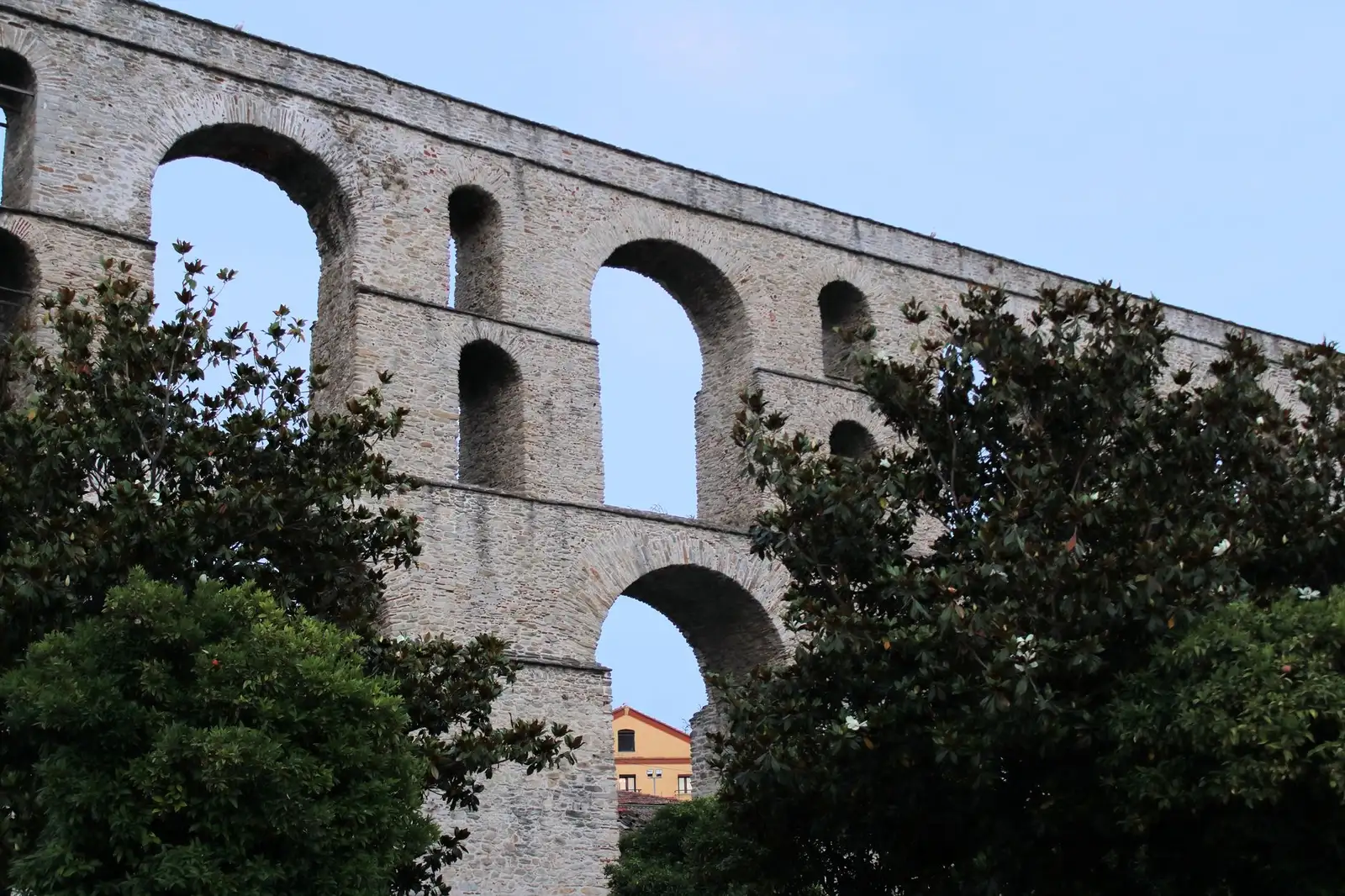

The arches at Parco degli Acquedotti
On a cold morning in February, the grass at Parco degli Acquedotti in Rome is stiff with frost and the arches of the Aqua Claudia run off toward the hills like a sentence that never finds its period. Dog walkers cut diagonal paths between the piers. A man practices trumpet under one of the arches because, he tells me, the acoustics are better there than in his apartment. Nobody treats the ruin as a ruin exactly. It is furniture. It has been furniture for roughly nineteen hundred years.
The Aqua Claudia was begun under Caligula in 38 CE and finished by Claudius in 52 CE, one of eleven aqueducts that eventually fed the city of Rome, carrying water from springs in the Anio valley some sixty-nine kilometers away. It ran mostly underground, as Roman aqueducts almost always did, and only rose onto the arcades visible today where the terrain dipped and gravity needed a lift of masonry to keep the water's fall constant. The arches are the part tourists photograph. They are also the smallest part of the system, the exception rather than the rule.
I start here because the usual way to talk about Roman aqueducts treats them as a feat, a triumph of hydraulic engineering to be marveled at and then filed away next to the pyramids and the Colosseum under "ancient achievements." That framing is not wrong. It is just thin. It measures the aqueduct the way you'd measure a bridge: by span, by load, by how clever the math was. What it misses is why the system kept working for centuries after the people who built it were dead, and in a few cases why pieces of it are still working now, while infrastructure built in the last fifty years, with better materials and far more precise calculation, routinely fails inside a single generation.
That gap is the subject of this essay. Not the cleverness of Roman engineering, but the durability of Roman intention: the way the aqueduct was embedded in law, labor, and civic identity so deeply that maintaining it became a cultural reflex rather than a line item. Call it existential sustainability, a term that has nothing to do with carbon accounting and everything to do with whether a society builds things that outlive the circumstances of their own construction.

Water that falls fifteen centimeters a mile
The central engineering problem of a Roman aqueduct was almost absurdly precise. Water moves downhill, so the channel had to drop steadily from source to city, but the drop had to be slow enough to avoid eroding the channel and fast enough to keep the water moving and clean. The Aqua Marcia, built in 144 BCE and the longest of the early aqueducts at ninety-one kilometers, lost an average gradient of roughly 30 centimeters per kilometer over its length, though actual stretches varied wildly depending on terrain, sometimes dropping far more sharply across a valley and almost not at all across flat ground. The surveyors who worked this out used a groma and a chorobates, a long wooden leveling tool with a water trough cut into its surface, and they did it across terrain they'd often never walk in a single trip, coordinating construction crews working from both ends toward a meeting point underground.
What's easy to miss, looking at the arcades, is that the overwhelming majority of every aqueduct's length was buried. The visible bridges, the Pont du Gard in southern France, the arcades at Parco degli Acquedotti, the aqueduct at Segovia, represent the sections where the land itself refused to cooperate with gravity's preferred path. Everywhere else, the specus, the covered channel, ran beneath fields and roads, inspected through manholes called putei spaced at regular intervals so maintenance crews could climb down and clear the limescale.
That buried, invisible majority tells you something the arches don't. The Romans were not building a monument. They were building a working system, and a working system needs access points, inspection routes, and crews who know where the access points are. The visible arcade is a photogenic fragment of a mostly hidden piece of civic plumbing, engineered for the part nobody was ever meant to look at: the part that had to keep being checked, cleaned, and patched for as long as the city wanted water. The aqueduct at Segovia, now a UNESCO World Heritage site, is built from granite blocks stacked without mortar, over a hundred and sixteen arches stepping down across the city's old town, and it carried water into Segovia until the late nineteenth century, roughly eighteen hundred years after construction.
The law that decided who got the water
Building the channel was the easy part, relatively speaking. Deciding who the water belonged to once it arrived in the city is where Rome's engineering becomes a social technology instead of a mechanical one.
Water entering Rome through an aqueduct passed through a castellum divisorium, a distribution tank that split the flow into pipes of calibrated diameter, the quinaria, each sized to deliver a fixed and measurable allotment. From there the water went three ways by law: first to public fountains and basins, free and available to anyone with a bucket, second to baths and other public amenities, and third, last in priority and first to be cut in a shortage, to private households that had paid for a connection, often illegally tapped or oversized, which is precisely the kind of corruption that got an entire book written about it.
That book is Sextus Julius Frontinus's De Aquaeductu Urbis Romae, written around 97 CE when Frontinus held the post of curator aquarum, the official in charge of Rome's water supply. Frontinus inherited an office that had existed since 11 BCE, and his treatise is, among other things, a furious audit. He catalogs the ways private citizens drilled illegal taps into the public channels, the ways contractors skimmed materials meant for repair, the ways previous administrations had let record-keeping lapse until nobody could say for certain how much water any given aqueduct actually delivered. He measured it all again. He is, as far as I know, history's first infrastructure whistleblower with a government salary.
What strikes me reading Frontinus is not the technical detail, though there's plenty, but the assumption running underneath it: that water distribution was a matter of public accountability, written down, checked, and defensible, because the aqueduct belonged to the res publica, the public thing, and a public thing has to answer to the public. The system wasn't just pipes. It was a legal and administrative structure built around the pipes, with a named official whose job existed specifically to keep the water honest. You cannot sustain a system for four centuries on good intentions. You sustain it on a bureaucracy that outlives any one administrator's tenure, which is a less romantic way of saying the same thing Frontinus would have said himself, had romance been his style.
Maintenance as a civic habit
Here is the fact that does the most work in this essay, and it's a quiet one: Rome maintained a standing workforce, paid out of the public treasury, whose entire job was aqueduct repair. Agrippa, as aedile in 33 BCE, is credited with organizing a corps of 240 slaves trained specifically in hydraulic maintenance, later expanded under the imperial system into the familia aquaria, a body of workers, some public slaves and later freedmen under salary, permanently assigned to patrol the channels, clear calcium deposits, replace cracked sections of lead pipe, and repair arcade damage from flood or frost.
This is the detail that separates the aqueduct from almost every piece of infrastructure built since. It was not finished and then left to decay gracefully, the way we build a highway overpass and revisit it only once the concrete starts spalling. It was built with its own aftercare budgeted into the system from the start, as a permanent institution rather than an emergency response. The aqueduct didn't survive four hundred years because Roman concrete was magic, although it held up better than most modern concrete, largely because of the volcanic ash, pozzolana, mixed into the mortar. It survived because somebody's job, every single day, was to walk the line and fix what had gone wrong that week.
Compare that to the usual modern pattern, where a piece of infrastructure gets a ribbon-cutting and a press release, and the maintenance budget gets cut in the first round of austerity because it produces no ceremony and no photograph. The American Society of Civil Engineers has graded the United States' overall infrastructure a C minus in its most recent national report card, citing a water system where a water main breaks on average every two minutes somewhere in the country. The problem in most of these cases isn't that nobody knew how to build a water system. It's that almost nobody is paid to keep walking the line.
There's an essay on this site, The hour before the town wakes, about the liminal moment in a European square when the day hasn't started and the previous day's mess hasn't been cleared. Someone has to clear it before anyone notices it was ever there. That's maintenance's whole character: it's invisible exactly when it's working, and it only becomes visible, loudly, the moment it stops.
Providentia and the planning horizon
Roman writers had a word for the kind of foresight that built things meant to outlast the builder: providentia, the virtue of looking ahead, distinct from mere caution and closer to a civic duty. It shows up constantly in how Romans talked about public works, not as engineering bravado but as a moral obligation owed to people who hadn't been born yet. Frontinus writes about the aqueducts almost as inherited trust, something handed down that he is answerable for passing along intact, or better, than he found it.
This isn't an idle philosophical point. It changes what counts as a reasonable planning horizon. A modern infrastructure project typically gets evaluated on a payback period of ten, twenty, maybe thirty years, matched to a bond cycle or an election cycle. The Aqua Claudia was in continuous operation, with periodic imperial restoration, for roughly three and a half centuries before Rome's aqueduct system began its long decline following the sieges of the fifth and sixth centuries, when Gothic armies cut the channels to starve the city and nobody with the authority or resources of an emperor remained to organize repair.
The philosopher's version of this problem has a name: intergenerational justice, the question of what obligations the present owes to people who don't yet exist and therefore can't vote, lobby, or sue. The Stanford Encyclopedia of Philosophy's entry on intergenerational justice lays out the basic difficulty plainly: any obligation to future people has to be justified without the usual tools of reciprocity, since the future can't do anything for us in return. Rome never solved this problem in the abstract, philosophical sense. But functionally, through providentia and through institutions like the curator aquarum, Roman civic culture built obligations to the unborn directly into the job descriptions of people who were very much alive, and who got paid and promoted for honoring them. That is a far more durable solution than any argument, however airtight, that lives only in a philosophy paper.
Flint, and the shape of short-termism
I want to be specific about the contrast rather than gesture at it, because "modern infrastructure fails faster" is a lazy claim unless it's tied to cases.
In April 2014, the city of Flint, Michigan switched its water source from Lake Huron, via Detroit's system, to the Flint River, as a cost-saving measure projected to save roughly five million dollars over two years. The river water was more corrosive than the treated Huron supply, and the state's environmental agency failed to require corrosion control treatment, which would have cost about a hundred dollars a day. Lead leached from aging pipes into the water supply for eighteen months before the crisis was publicly acknowledged, exposing thousands of children to elevated blood lead levels with effects that, unlike a cracked aqueduct arch, can't be repointed with mortar.
The decision that caused the Flint crisis wasn't a failure of engineering knowledge. Corrosion control chemistry has been well understood since well before 2014. It was a failure of the kind of institution Rome built around its water: a standing authority with the budget, the mandate, and the cultural expectation that someone's actual job is to keep checking. Flint had an emergency manager appointed by the state to cut costs, operating on a horizon measured in budget quarters, not generations. There was no equivalent of the curator aquarum answerable to a public record that anyone, in principle, could demand to see.
The Organisation for Economic Co-operation and Development's work on infrastructure governance makes a version of this same argument in drier language, noting that long-lived assets like water systems require governance structures that outlast the political cycles in which they're funded, and that short planning horizons are one of the most consistent predictors of infrastructure failure across member countries. Rome, without the vocabulary of modern governance theory, arrived at the same conclusion by trial, scandal, and Frontinus's audit.
What systems thinking calls resilience
Systems thinking has a useful distinction here between efficiency and resilience, and it's worth being precise about it because the two get collapsed together constantly in infrastructure debates. An efficient system does the most with the least, optimized tightly to its expected conditions. A resilient system has slack built in, redundancy, buffer, the capacity to absorb a shock that falls outside the range it was optimized for. These two properties often trade off against each other directly: the leanest, most efficient system is usually the most brittle one, because every bit of slack that could have cushioned a shock has been stripped out in the name of savings.
Rome's aqueduct network had enormous built-in redundancy by design, not accident. Eleven separate aqueducts fed the city by the early third century, drawing from different sources at different elevations, so that damage to one line, from an earthquake, a flood, or an enemy cutting the channel outside the walls, didn't mean the city went dry. The castellum divisorium system, splitting each aqueduct's flow across multiple destinations, meant that even partial failure still left some water moving to some part of the city. This is expensive. It is also why the system kept functioning, in reduced form, through centuries of political chaos that would have killed a leaner, more efficient single-source design on the first bad year.
Modern cost accounting tends to treat redundancy as waste, because it shows up on a balance sheet as duplicated infrastructure nobody's using most of the time. The counterargument Rome made, unintentionally, across four centuries of continuous operation, is that redundancy is not duplicated infrastructure. It's the system's memory of every disaster it hasn't had yet. You only find out what it was worth the one week you need it.
The water that's still running
Not all of it is gone, which is the part that undercuts any temptation to romanticize collapse too neatly.
The Fontana di Trevi in Rome is fed, substantially along its ancient course, by the Acqua Vergine, originally built by Agrippa in 19 BCE and restored and reopened by Pope Pius IV in 1570 after the medieval line had fallen into disrepair during the long centuries when Rome's population and its aqueduct maintenance both collapsed together. Tourists throw coins into water that has, with interruptions measured in centuries rather than years, been moving along roughly the same channel for over two thousand years. The aqueduct at Segovia carried water into the city until 1884, when a new pumping system finally replaced it, not because the Roman channel had failed but because the city had simply outgrown what gravity alone could deliver.
That's a strange kind of continuity to sit with. Most of what the Romans built is gone, or standing as a fragment, or repurposed into something its builders wouldn't recognize. The aqueducts are different because the thing they were built to do, move water downhill from a clean source to a thirsty city, never stopped being a thing cities need, and the physical answer to that need, slope and channel and gravity, hasn't changed since the first aqueduct was dug. There's no obsolescence curve on gravity.
There's a short piece on this site, Forgotten postcards from a forgotten roadside stop, about a rack of old postcards outside a tabacchi on the Via Cassia, the old Roman road north out of the city. The road is still there under the modern asphalt in places, the way the aqueduct is still there under the fountain. Rome's infrastructure has a habit of refusing to fully disappear even when everyone stops paying attention to it, which is either the most hopeful or the most unsettling thing about it, depending on the week.
Progress measured by what it outlasts
The word "progress" usually gets attached to whatever is newest, fastest, or cheapest to build, which is a strange standard if you think about it for more than a minute, since newest and fastest are the two qualities least correlated with lasting. The aqueduct suggests a different measure: progress as whatever a society builds that it can still maintain, legally and institutionally, after the people who built it are gone.
By that measure, a lot of what gets called progress now would fail the test the aqueduct passed. A water system engineered to minimum code, financed on the cheapest available bond, staffed to the leanest number legally required, and handed to the next administration with no particular expectation that anyone will keep inspecting it, is not progress in the Roman sense. It's deferral. It moves the cost of maintenance into the future and calls the savings a win, the same arithmetic that ran through Flint's decision and a hundred smaller, quieter versions of it in water systems nobody's written an article about yet.
Simone Weil wrote, in a line a translator rendered for this site in The glow of streetlamps through morning fog, that the world is not a problem to be solved but a living being to which we belong. The aqueduct, oddly, reads as a built version of that idea. It wasn't solved once and then finished. It was tended, the way you tend something alive, because the Romans who ran it understood, in a way we keep having to relearn at considerable cost, that anything that moves water, or power, or food, or care, from one place to another over time is never actually finished. It just stops being tended, eventually, and that's when it starts to look finished, right before it stops working.
A second morning at the arches
I went back to Parco degli Acquedotti a few days before leaving Rome, earlier this time, before the dog walkers. The frost was heavier. A heron stood in the shallow pool that collects at the base of one of the arches where the modern drainage doesn't quite match the ancient grading, and it didn't move as I walked past, close enough to see the water bead on the stone.
Nobody built that pool on purpose. It's a flaw in how the ground around a two-thousand-year-old structure interacts with twenty-first-century storm drainage, and the heron clearly doesn't care whose infrastructure made the puddle. But standing there, I kept thinking about the curator aquarum's inspection routes, the putei spaced along the buried channels, the crews who walked this line not for glory but because it was Tuesday and the aqueduct needed checking again. Nobody remembers their names. The water in front of me, four stories of Roman stonework holding up a channel that stopped carrying water sometime in the sixth century, is still, in its way, the proof of their work. It outlasted the empire that paid them. It's outlasting most of what's been built since.
If you want a single piece of advice out of all this, here it is: the next time a city, or a company, or a government announces an infrastructure project with a ribbon and a press release, ask who's getting paid five years from now to walk the line. If the answer is nobody, you already know how the story ends. The Romans knew it too, which is the only reason any of this is still standing.



Comments (0)
No comments yet. Be the first!